← All games
PlayableBeta

Beta: the port plays, but nobody has played it through by hand yet, so it may still have mistakes the tests did not catch.

Risk

Tone (Antonie J.) Engel and Mark Briggs · 1985–86 · Macintosh 68k · ported from version 1986

The board game of armies and world conquest, for up to six players, human or computer: Tone Engel and Mark Briggs's Risk for the Macintosh.

Risk is the board game of armies and world conquest, for up to six players, human or computer, as Tone (Antonie J.) Engel and Mark Briggs made it for the Macintosh in 1985 and 1986, on a map of 42 countries and six continents. This port follows the 1986 version. Its rules (income, cards, battles, conquest and elimination) match the original running in an emulator, and its three computer players, Mac1, Mac2 and MacChaos, play whole games as the original's do.

What you need

Screens

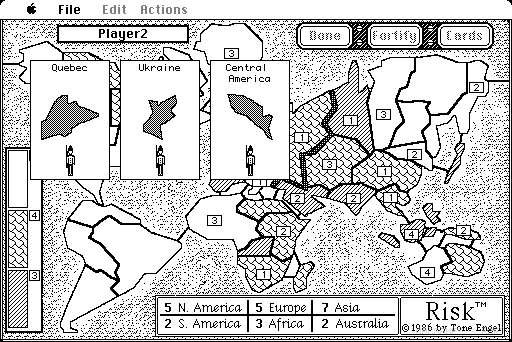
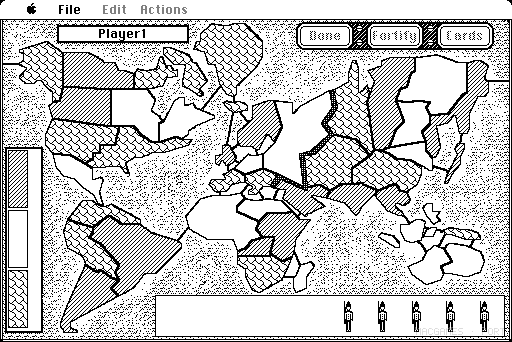
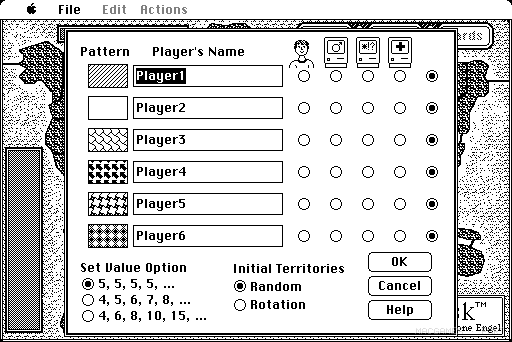
Taken from the port; open one to see it at the screen's own size.

What you need

Your own copy of Risk version 1986. These are the files the port uses, each checked by its size and checksum; a copy is recognised whatever disk image or archive it is in. It is read in your browser and never uploaded.

FileNeededSizeChecksum (SHA-256)
Riskyes119 KB0c6cf647d07f7e78…

Drop it on this page or the home page: a disk image or an archive (.dsk, .img, .image, .sit, .sea, .cpt, .hqx, .bin, .zip); the page looks inside. A System file is optional: with one (System 7.1's is best), menus and dialogs use the Mac's own fonts, and with 7.1 its arrow and Color Picker too.

How complete the port is

  • DoneThe reference is chosen: the 1986 Risk, from the original archive, and the site recognises your copy of its application
  • DoneThe licence is looked into: no permission to copy it was found, and the name and rules are Hasbro's, so you bring your own copy
  • DoneThe game's files are read: the map with its 42 countries and six continents, the pictures, icons, patterns, dialogs and the saved-game format (a viewer page shows them)
  • DoneThe original runs in the toolkit's emulator, from start through New Game to a whole game between computer players, which checks the port
  • DoneThe random numbers, the floating point the game uses, a new game (players, patterns, dealing or choosing countries) and a turn's rules (income, cards, battles, conquest, elimination) are ported and match the original
  • DoneThe three computer players (Mac1, Mac2 and MacChaos) play whole games as the original's do, and a human takes a turn by clicks and buttons: placing, attacking, fortifying, cards
  • DoneThe drawing: the map with the countries filled by owner, the armies, the player panel, the highlights and the blinking country
  • DoneThe dialogs (New Game, Player Info, Combat Options, Cards, Report, About, Help), the seven alerts, the menus with the original's enabling, and the beeps
  • DoneSaved games in the original's file format, kept in this browser: Save keeps the game, Open and Play bring it back
  • DoneThe whole game on the page: the loop at the original's clock, the computer players' turns shown as they happen without freezing the page, Quit leaving full screen
  • DonePlacing armies by dragging the icons onto a country, as the original, and a computer player's card trade shown where the original shows it
  • DoneEvery routine of the original is accounted for (the audit), and the game has its README
  • OpenSave as… waits for a Mac file dialog; until then the page keeps one game in this browser

Every part is compared with the original code running in an emulator. How ports are verified

Your copy and saved games

Your copy is kept in this browser only. Saved games are kept by the game itself, in this browser too.